Levels that look like geology.
Peter and Anna Nguyen spent four years designing and building their house on the Tasman Peninsula. They knew the site was steep. The architect had drawn outdoor terraces into the plans — spaces that connected the house to the slope below it, places to sit, to move through, to watch the bush.
When the build finished, those spaces existed in outline. Posts, a rough level, a view of what they might become. They weren't usable. They weren't connected to each other or to the house.
"We'd put everything into the build," Peter says. "When it was done we just lived with the outside as it was. For longer than we should have."
The site drops steeply from the house toward the tree line — native bush on three sides, the kind of dense, layered growth that the Tasman Peninsula carries at mid-elevation. The slope creates significant engineering problems: retaining against the load of water moving downhill, drainage that doesn't undercut the foundations, access that works in wet weather and dry. Get the engineering wrong and the terraces move. Get the drainage wrong and the problem presents itself three years later in the worst possible way.
Will spent the first visit with a level and a notebook, not a sketchbook. The terraces needed to resolve the slope before they could resolve anything else.
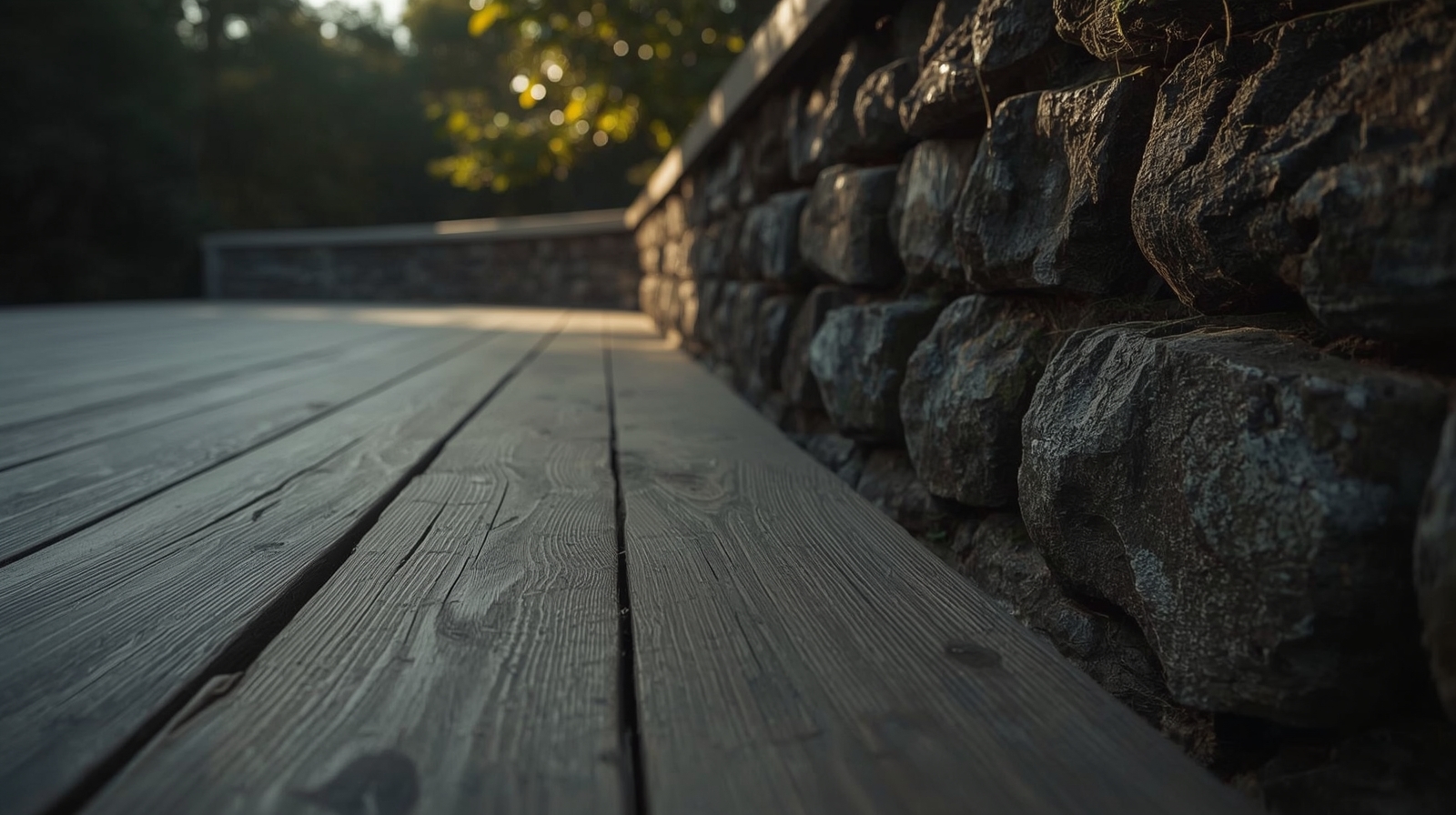
He built the retaining walls in dry-stone — material sourced locally, laid without mortar, with the slight irregularity that comes from hand-selecting each course. The same technique as the original field boundaries that run through the surrounding country. Timber from a mill on the peninsula forms the deck surfaces and the steps between levels: hardwood, unfinished, the kind that silvers in the weather rather than requiring maintenance.
Each terrace is oriented differently. The uppermost faces north toward the sun. The middle level opens to the bush canopy to the east. The lowest sits at the tree line — partly sheltered, a different temperature and quality of light from the levels above it. Three outdoor spaces that feel like three different places, connected by steps that descend as naturally as a change in gradient.
The drainage runs beneath it all, quietly, doing its job.
The work took fourteen weeks. The first winter after it was finished, the terraces held without movement. The stone darkened in the wet. The timber began to silver. The bush grew a little closer at the lower level.
"Visitors ask who carved it out of the hill," Peter says. He lets it sit for a moment. "Nobody carved anything."