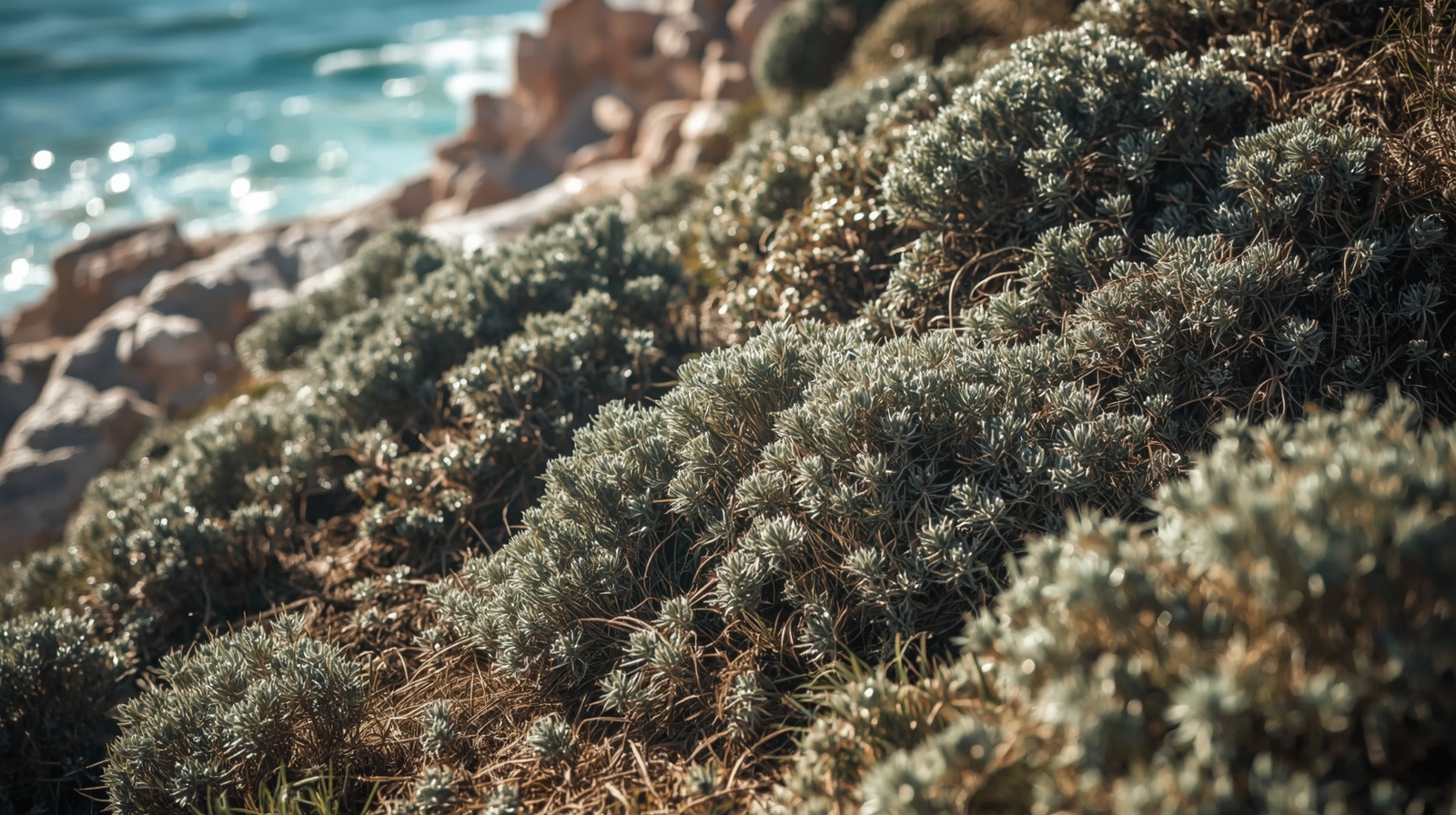
Planting for a site that doesn't forgive mistakes.
The view from the Delaney property takes in the full sweep of Great Oyster Bay — water to the horizon, the pink granite of the Hazards to the north, nothing between the deck and the Tasman Sea but a north-facing slope and whatever you're willing to plant on it.
Martin Delaney describes the site the way people describe difficult country. With respect.
"Everything we put in either burned off in the first summer or got shredded by the wind," he says. "We stopped planting for two years. Just accepted it was going to stay the way it was."
The way it was: a slope of shallow, rocky soil, largely bare, technically the garden of a house they'd spent three years building. Coastal sites near Freycinet carry salt on every south-westerly. The soil depth above the granite shelf varies from twenty centimetres to almost nothing. In a dry summer the exposed faces get forty-degree heat reflected off the rock below. In winter the wind comes off the water unimpeded.
The views were the whole reason they'd chosen the site. Screening the exposure wasn't an option.
Will came out in late autumn. He came back in winter. Then again in early spring.
He didn't plant anything.
"I thought something had gone wrong," Martin says. "I asked him what he was waiting for. He said he wanted to see where the water went."
What Will was reading: the drainage pattern across the granite shelf, the specific wind direction that carried the most salt load, the aspects that got morning sun versus afternoon exposure, the hollows where soil had naturally accumulated deeper over decades. The site had a logic. It wasn't obvious, but it was there.
The planting that followed was built entirely around species that already understood how to live on the Freycinet coast — coastal wattle, native grasses, prostrate forms that moved in the wind rather than broke against it. Nothing exotic. Nothing that would need intervention in a hard season. Root systems chosen for their grip on shallow soil over rock. Spacing determined by the water movement he'd spent three months watching.
No irrigation. The site had always had enough water. It just needed plants that knew how to find it.
The garden established quietly over eighteen months. The Delaneys watched it without expecting much.
"The first summer after it went in, nothing died. That sounds like a low bar. It wasn't."
— M. Delaney, Coles Bay
Three years on, the slope reads as continuous with the surrounding coastal scrub — the same low horizontal profile, the same movement in the wind, the same quality of having always been there. The views are unobstructed. The house sits in the landscape rather than on it.
We assumed landscaping this close to the water was always going to be a compromise. Martin pauses. It isn't.